Check the data under your AI before you build on it.
The Diagnostic is a fixed-scope first step. We look at your sources, build a small working prototype on data shaped like yours, measure what it will cost to run, and hand you a plan in priority order. Typically 2 to 4 weeks.

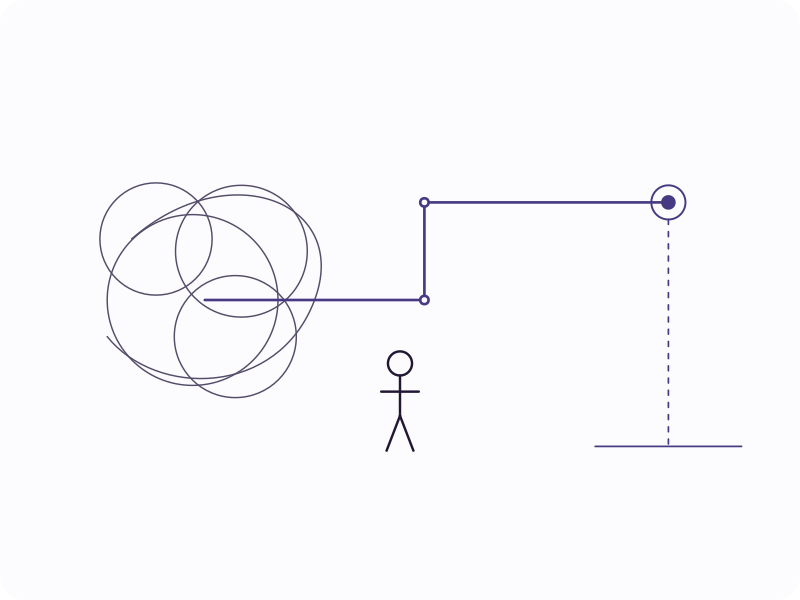
Most AI plans skip the data question
A chatbot demo works on a clean sample. Then it meets your real systems: three customer IDs for the same account, a revenue number finance and sales define differently, and documents nobody owns.
An audit of which AI tools your team uses tells you about the tools. It does not tell you whether the numbers underneath are right, who is allowed to see them, or what the platform bill will be.
Those are the questions that decide whether an AI project ships or stalls. The Diagnostic answers them first, on your data, in weeks.
Typically 2 to 4 weeks
The pace depends on how quickly your team can grant access, share documents, and join short interviews.
- Week 1Frame and collect metadata and samples
- Week 2Map sources, quality, and ownership
- Weeks 2–3Build and run the prototype
- Weeks 3–4Cost baseline, plan, and handover
Four steps, one fixed scope
Frame
We agree on one or two business questions that matter, and the decisions they drive. You fill in a short questionnaire.
Inspect
You share a metadata export and sample data from each source. We map where the data lives, who owns it, and where it disagrees.
Prove
We build a small prototype on data shaped like yours and run it, so the cost baseline comes from a real run, not a vendor estimate.
Plan
You get a roadmap in priority order. Build it with us, with your own team, or with anyone.
What we actually look at
Sources and ingestion. Each source system, its export options, volume, and change rate. We recommend a raw landing (bronze) design that keeps full history so you can reprocess and audit.
Quality and meaning. Duplicate keys, nulls, late-arriving records, and conflicting definitions. We prototype cleaned (silver) tables and business-ready (gold) tables for your core reporting.
Governance. Who owns each dataset, who should see which fields, and how lineage is tracked from source to report. On Databricks this maps to Unity Catalog access rules, lineage, and audit logs.
Cost. We run simulated data at your volume and record compute and storage use, then build a cost calculator you keep.
AI readiness. Which questions an agent or natural-language tool could answer safely today, and what has to be fixed first.
Signs you need a Diagnostic
Two versions of the truth
Finance and sales bring different numbers to the same meeting.
An AI pilot that stalled
It worked in the demo and broke on real data, or never got past security review.
A platform decision coming
You are about to commit to a platform and want the cost measured, not guessed.
Data spread across tools
CRM, ERP, billing, spreadsheets, and shared drives, with no single owner.
A board asking about AI
You need a plan you can defend, with costs and an order of work.
Deliverables
A source-system kit: an inventory of your sources and a recommended ingestion design.
A working prototype: cleaned and business-ready tables for your core reporting, plus a query interface your team can try.
A measured cost baseline from a real run at your data shape, and a calculator to test other scenarios.
A governance map: owners, access rules, and lineage for each key dataset.
A prioritized plan: a roadmap and feature checklist in order of business impact.
A knowledge kit: notes, decisions, and a skill library your team keeps.
When the prototype should run there
If you already run Databricks, the prototype runs in your workspace. If you do not, the Diagnostic tells you whether it fits, and what it would cost to run, before you sign anything.
The same questions apply on the platform you have. The first slice of a governed home for the data is the Knowledge Lakehouse.
We work from metadata and sample data, in your cloud where possible. Access is least-privilege and removed at handover. Sensitive fields are masked in the prototype. A deeper security assessment is available through a trusted local partner.
References
What is the medallion lakehouse architecture? Databricks documentation. https://docs.databricks.com/aws/en/lakehouse/medallion
What is Unity Catalog? Databricks documentation. https://docs.databricks.com/aws/en/data-governance/unity-catalog/
NIST AI Risk Management Framework. https://www.nist.gov/itl/ai-risk-management-framework
See whether a Diagnostic fits.
Start with a free discovery session, or try the agent in the Lab first.