Ask your business a question. Get an answer you can check.
Plain-English questions answered from your own data, with the query and the source shown every time.

Signs you need one
One analyst, many requests
Your data person spends most of the week on one-off pulls.
Leaders wait for answers
A simple question from the CFO or COO takes days to answer.
Dashboards nobody opens
You paid for reports, but people still ask for spreadsheets.
AI trials you can't trust
Someone tried a chatbot on your data and the numbers didn't match finance.
Good questions wait in a queue
Most mid-market companies can't justify a full data science team. The questions still come every week.
Dashboards answer the questions someone thought of last year. A new question goes to an analyst's queue and comes back days later, if at all.
Generic chatbots guess. Without your definitions, they join the wrong tables, mix fiscal and calendar periods, and ignore who is allowed to see what.
The business steps
Collect
We gather the 30 to 50 questions your leaders actually ask, in their words.
Ground
Each question is tied to approved tables and metrics your finance team already trusts.
Test
We run every question against known answers before anyone outside the pilot sees it.
Launch
A pilot group uses it for real work. We review answers weekly, fix misses, and widen access.
Deliverables
A list of your leaders' real questions, each tied to approved data.
A Databricks Genie agent, or an equivalent, tuned with your terms, metrics, and example queries.
Metric definitions written once in Unity Catalog and reused everywhere.
A benchmark question set with known answers, and its scores at launch.
A short playbook for your team on asking, checking, and extending.
What's under the hood
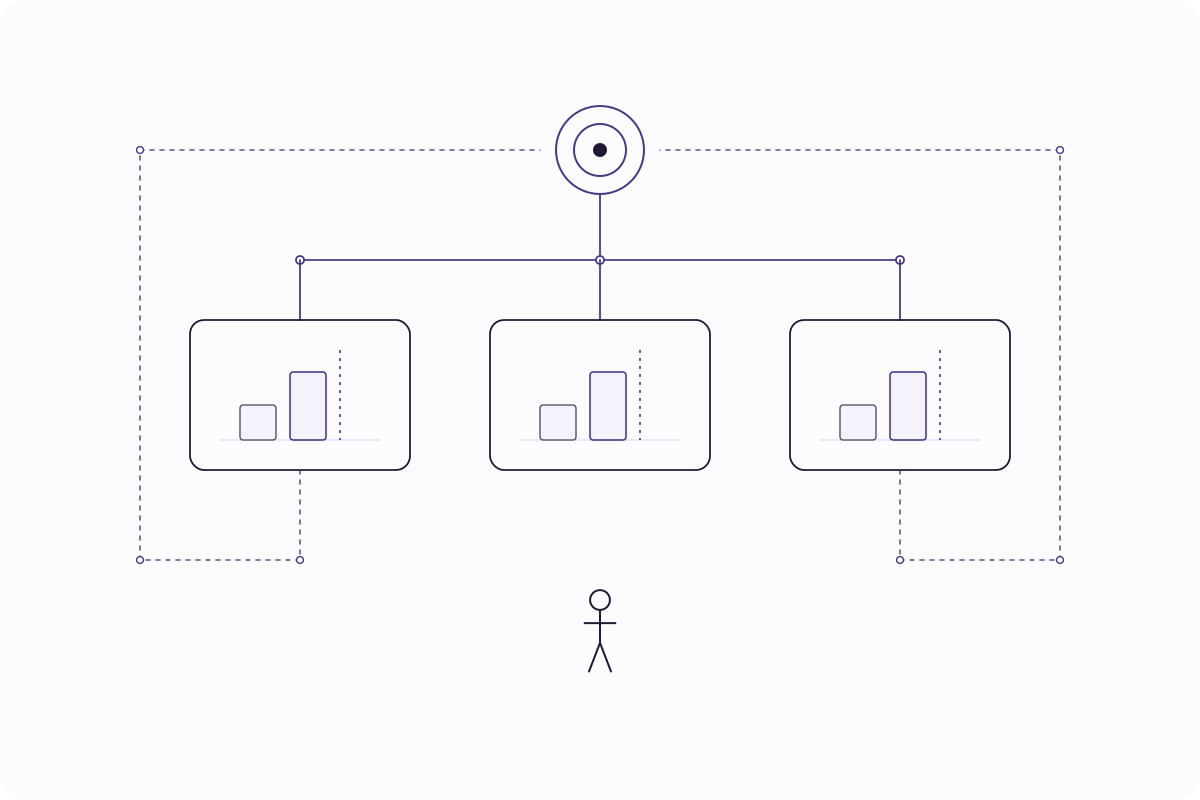
The question space. A small, focused set of gold tables or metric views, five or fewer to start. A focused agent answers more accurately than one pointed at everything.
Business meaning. Metrics like revenue, active customer, and gross margin are defined once as SQL expressions or metric views. Column descriptions and synonyms live in Unity Catalog.
Worked examples. We give the agent verified example queries for the hard, multi-step questions, and use plain-text instructions only where SQL can't express the rule.
Benchmarks. A benchmark set of questions with known answers is scored before launch and again after every change. Research benchmarks such as BIRD show why: even strong text-to-SQL systems still miss on messy real-world databases.
Show your work. Every answer shows the generated SQL and the tables it used, so anyone can check it.
Genie, grounded in your catalog
Databricks Genie agents turn plain-English questions into SQL over tables governed by Unity Catalog. Databricks' own guidance says the same thing we do: accuracy comes from well-described data, defined metrics, and tested examples, not from the model alone. Because Genie runs on Unity Catalog permissions, people see only the rows and columns they're allowed to see. Usage shows up in the audit logs. No clean foundation yet? Start with the Knowledge Lakehouse.

Live with a pilot group in 2 to 4 weeks
This assumes governed tables already exist. If they do not, pair it with the Knowledge Lakehouse.
Collect and ground
Question list, mapping to approved tables and metrics.
Tune and test
Definitions, synonyms, example queries, and benchmark runs.
Pilot and widen
Pilot users, weekly answer review, and playbook handover.
People only get answers from data they're allowed to see, and every answer shows its query and source. Access control, audit logs, and answer monitoring are part of the build. For a deeper security assessment, we bring in a trusted partner.
References
Curate an effective Genie agent. Databricks documentation. https://docs.databricks.com/aws/en/genie/best-practices
What is Unity Catalog? Databricks documentation. https://docs.databricks.com/aws/en/data-governance/unity-catalog/
BIRD, a benchmark for database-grounded text-to-SQL. https://bird-bench.github.io/
Bring the question that takes too long to answer.
In a free discovery session we check whether your data can answer it today and what a pilot would need. Or ask it in the Lab first.