Every visitor gets the right door
Customers get identified and routed to the optimal path for their profile or profitability. Search crawlers and AI agents get a side entrance with identification and ground rules. Scrapers, fake accounts, spam, and fraud get slowed, stopped, or sent to your team. Threatening emails or social media posts captured, stored, and reported. We build the pipeline and the classifiers and decision models that work in real time, on your own data and on your terms.
How much of your traffic is a customer?
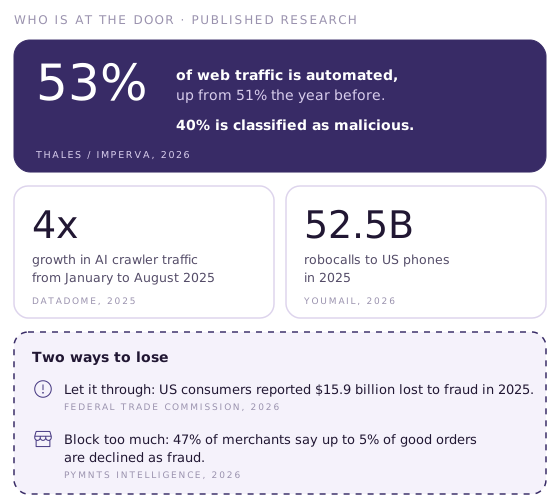
More than half of web traffic is automated, and the share rises every year. Some of it you want: search crawlers, AI assistants, partner systems, agents shopping for a real buyer. Some of it only costs you: scrapers, click bots, fake sign-ups, spam calls and messages.
You pay for all of it. Your servers answer it. Your ad budget buys its clicks. Your dashboards count it as demand.
The usual fix has a cost too. Nearly half of merchants say their fraud checks turn away good orders. Block too little and you lose money. Block too much and you lose customers.
So the job is to sort: quickly, with an error rate you can read, and with a response that fits each kind of visitor.
Where each request goes
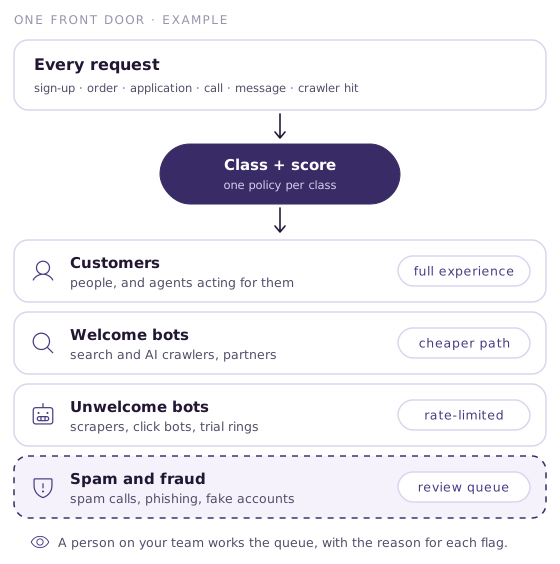
Four lanes, one policy each
Customers
People, and agents buying for a signed-in customer. Everything, at full speed.
Welcome bots
Search and AI crawlers, partner systems, agents comparing prices. A cached page or a feed, counted apart.
Unwelcome bots
Scrapers, click bots, probing engines, trial-abuse rings. Slowed, held, or served a decoy.
Spam and fraud
Spam calls, phishing, fake accounts, chargebacks, application fraud. A person sees each one, with the reason.
A custom classifier, then a decision model
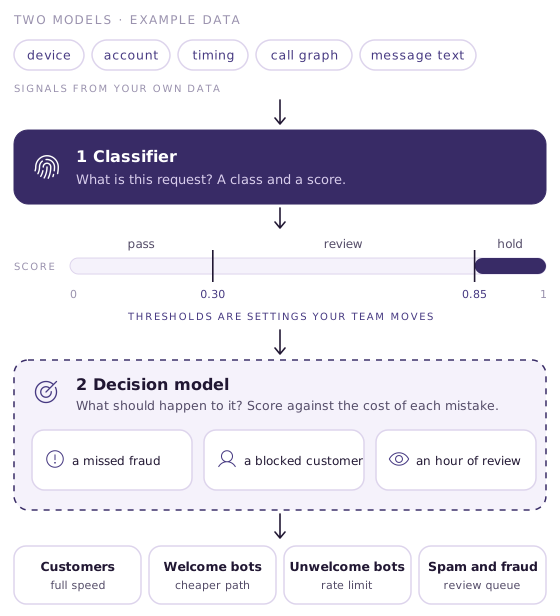
What is this request? And what should happen to it? Those are two questions, and we build a model for each.
The classifier answers the first. It reads the patterns in your own data, such as device, account, timing, call graph, and message text, and gives every request a class and a score. A packaged filter sees one request at a time. A classifier trained on your history sees the pattern across all of them.
The decision model answers the second. It weighs the score against what each mistake costs you: a missed fraud, a blocked customer, an hour of review. The thresholds are business settings. Your team moves them, and a new crawler gets a lane without a vendor ticket.
Both run in real time, so traffic is filtered out and waved in as it arrives. A DataMind Diagnostic is where we size it: the streams, the labeled cases you already hold, and the number that should move.
The loop keeps it working
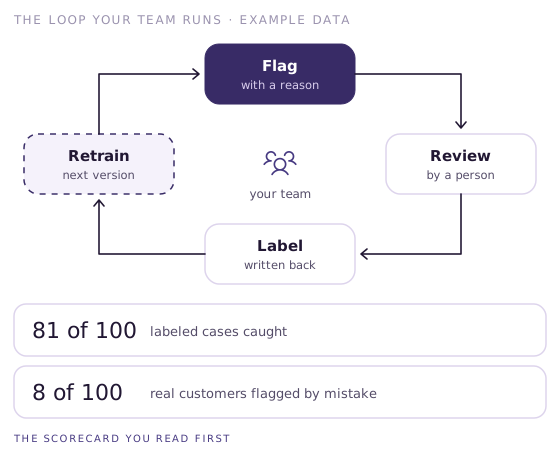
Fraud changes every month. A model that is right at launch drifts.
So every flag carries its reason. A person on your team reviews it, and that decision becomes a label for the next version. Each version is tested on the latest month, watched for drift, and retrained on a schedule your team owns.
Flagged traffic is marked where it lands, so your metrics and your other models count real customers only. Your payment processor's checks and your bot filter stay in place. We score what gets past them.
Your team keeps all of it: the labeled cases, the features, both models, and the scorecard, in your own cloud account and your own repo.
Three systems, billions of decisions
We have built custom classifiers and decision models for search, for voice, and for school safety. What we carry from all three: the threshold is a business setting, and the label loop matters more than the algorithm.
Bing (Microsoft): click bots and probing engines
Feature pipelines and real-time automated detection of click bots on search ads, and of competitor engines probing the ranking model to estimate the depth of and gaps in the index. Each got a class and a policy. We helped drive Bing's search share from under 10% to over 30%.
Voice spam and fraud
Spam detection and mitigation for major US wireless carriers, ranking billions of calls in near real time. Full MLOps moved model releases from every 18 months to monthly and lifted detection from near coin-toss to over 90% precision and recall.
School safety: one platform, pipelines to serving
Threat detection for a national ed-tech safety provider, scoring email and social streams to surface threats to schools and students before they emerge. One Databricks platform for pipelines, data science, and model serving, with MLOps, for 31,000 school districts.
The people who built those three, on your streams
Twelve years at Microsoft, lead data scientist to the CSO and CFO. Senior data leader in telecom and ed-tech. MBA, Economics, Entrepreneurship and Technology. MS, Data Science.
Shipped machine learning inside Microsoft products (co-inventor, Microsoft patent US 10,839,149 B2). Databricks Certified Data Engineer Professional.
We build it, with our network of experts: senior engineers, data scientists and security partners we have worked with for years, brought in when the work needs them.
References
YouMail Robocall Index, reported Jan 14, 2026: 52.5 billion robocalls to US phones in 2025
Bring the number you want to move.
In a free discovery session we pick the stream, the number, and the first lane, and say what it would take. If your bot filter or your processor's tools would do the job, we say so.